If you’ve been looking to learn Hindi but finding it hard to find a tutor around you, you’re at the right place. The internet today is so filled with language learning tools and resources that identifying the right one is trickier than ever. There are books, websites like this, apps, YouTube videos, tutors online, and finding the right place to get started is harder than ever. Here’s your ultimate guide to Hindi classes online.
I believe that you will never have one single resource that does it all. Which is why I have a book, this blog, an upcoming app, and more to come! What matters is that you learn the language, and not the tool you used to learn. Find the method that works for you.
I’m here to simplify this for you.
Will Hindi Classes Online help me at all?
I get it. Most of the internet is plastered with low-value content all around it. With so much content all around us, it is hard to find out the exact content gaps in place.
Here’s the hard truth – Hindi classes online will be a great resource only if you are motivated. But if you aren’t, nothing can actually teach you. You decide how far you want to go with the language.
From my personal experience with learning a language online (I’m trying German at the moment), to learn a language you need the following:
- A “starter’s” guide, which teaches you sentence construction and gets you to speak basic conversations.
- An intermediate guide which exposes you to advanced vocabulary in the language
- Consistent exposure to the language and opportunities to talk in the language regularly
- Language immersion with a native speaker who will expose you to the cultural nuances of a language.
- A lot of motivation!
Often times, these can all be accomplished by the same person (eg: a live teacher) if you can get one, but if not, let’s look at these individually to identify the best approach.
Starter’s guide to Hindi Classes Online
To get started with Hindi, start with the simpler exercises. If you have a friend or a partner around you who speaks Hindi, pick a few words they are speaking. If you are already speaking, download an app like Duolingo or Pimsleur that can help you get started with the basics. Hindi Hacking is a great resource to get you started as well.

The goal here is not to get fluent in Hindi, but to develop a genuine interest in the language. If you start without giving this time, you may develop learning fatigue driving you away from the language. The best way is to start slow and give it a month or two to get familiar with the language structure – sentence construction, genders, some common greetings, etc.
When you get bored and feel like you are no longer being challenged, move on to the next stage.
Upgrading to the intermediate level
If you feel you’re getting the hang of it, it is now time to graduate to the next level. I recommend learning from a tutor at this stage, even if you are looking to learn online. A few live classes with a tutor would take you much further than subscribing to an app for years without real progress.
If you can’t find a tutor online, the next best thing is to look at online video programs where you can at least get asynchronous feedback. My recommendation is to check hindipod101.com. They have several plans and the highest tier offers personalized feedback to help you conversational quickly.

From the HindiPod101 website
You can also check out courses on Udemy that allow you to learn at your own pace. These are typically not expensive, and can get you the essence of the language quickly. In fact, Udemy offers several courses that are designed for your use cases and your level of speaking.
This course, by Shachi Chotia, has a 4.7 star rating from more than 2000 students. The course starts with basics and goes into the details of writing in Hindi, but you can skip those sections unless you get fluent with talking Hindi. The course also includes a lot of practice materials, which will help you get conversational faster.

Beyond this intermediate level, I will leave it up to you to figure out what you want to learn.
The next most important thing is talking and gaining more exposure to the language, which we’ll cover next.
Consistent exposure to language
Any amount of theoretical learning is not going to prepare you for conversation. When people talk to you, you not only need to respond, but respond quickly to hold their interest. For this, consistent exposure and opportunities to practice Hindi are important.
Here are some ways you can gain consistent exposure and opportunities to practice:
Bollywood: Watch Bollywood films with subtitles, pause often and try to repeat the dialogues in Hindi. Don’t forget to grab popcorn while you learn, though!

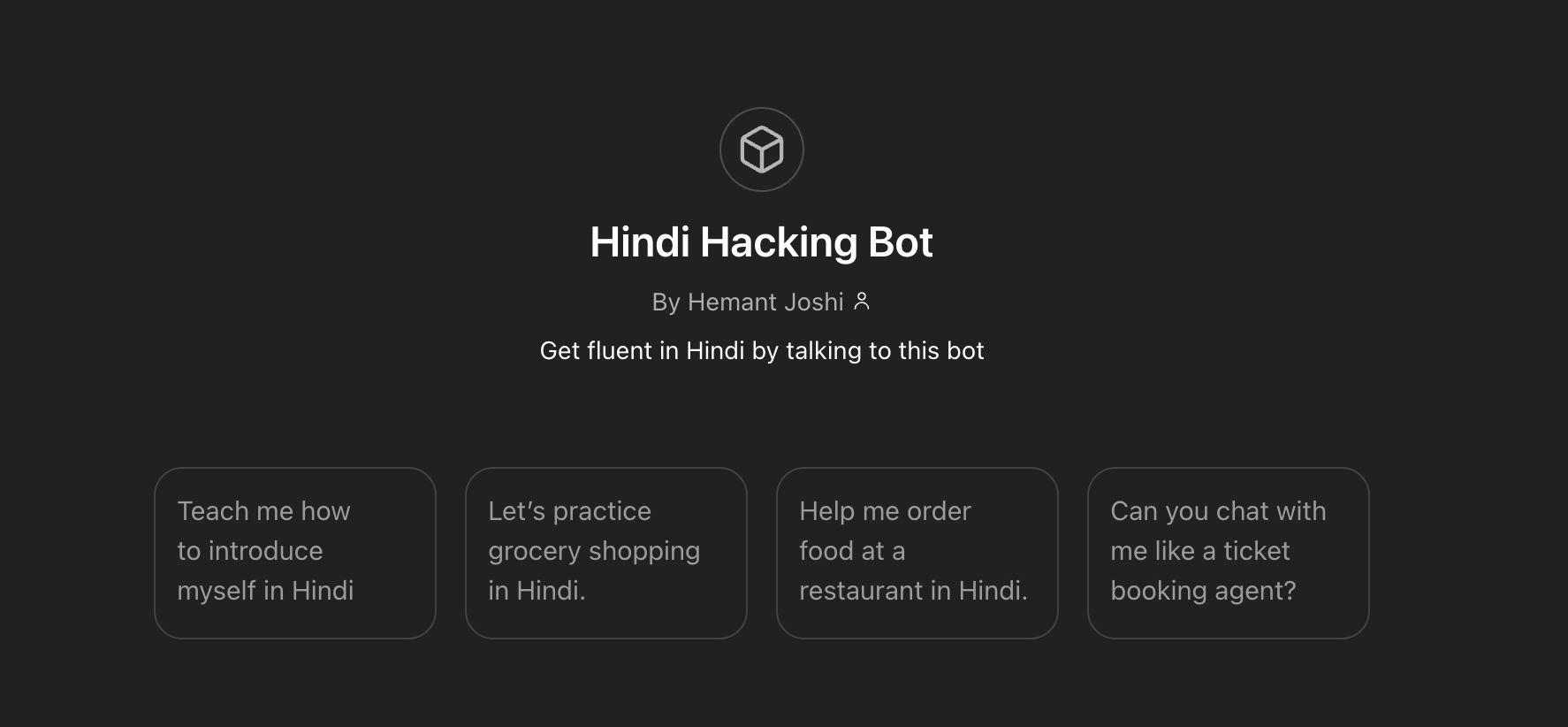
Leverage chatGPT voice mode: ask chatGPT to have a conversation with you about a scenario. This is my favourite way of practicing dialogue. You can ask it to slow down or speed up depending on your needs. Go wild! Do this for a few minutes every day, and you’ll be fluent soon. I created this (completely free) custom GPT to help you read and write Hindi. The GPT doesn’t work on voice yet, but I’m trying to create a resource for this soon.

Find a learning buddy: someone who is learning Hindi but is a little further ahead than you. They can teach you the mistakes they made which you won’t have to repeat.
Language immersion with a native buddy
Next step towards fluency is to converse with a Hindi speaking person regularly.
- Find a person willing to talk to you. If needed, bribe them with whatever you can. Nothing beats a human who you can talk to for an hour a week. One hour a week will get you there within weeks of practice, vs months of practice on any app.
- Travel to north India! If you have a friend who’s inviting you – take up the offer. Of course, the travel and exploration is the primary purpose of the trip, but practicing your Hindi would be an added bonus. Language learning is all about culture, and what better than to travel the streets of a north Indian city?
The one thing you need through all this is to stay motivated. And that comes from a curious passion for learning, which I’m sure you’ve developed if you’ve gone this far.
Some additional tips:
What to Look for in a Good Online Hindi Class
When you’re evaluating options (Udemy, ipassio, websites, private tutors etc.), here are some criteria that help pick well.
- Goal-oriented curriculum: Does the course clearly say what you will be able to do? (e.g., introduce yourself, order food, travel, write letters).
- Balanced skills: Speaking, listening, reading, writing. Depending on your goal, you might prioritize some more, but the class should let you practise all.
- Native or fluent teacher(s): Ideally someone who knows real-life spoken Hindi, idiomatic usage, slang, cultural nuance.
- Interactive components: Live video, feedback, quizzes, speaking practice, peer / group work etc.
- Quality of learning materials: Good audio, clear visuals, well-structured lessons, usable practice worksheets etc.
- Flexibility: Can you reschedule lessons? Is there a pacing option (fast / slow)? Can you access recordings?
- Support & feedback: Corrections (pronunciation, grammar), tutor / mentor support, opportunity to ask questions.
- Cost & value: Upfront cost, hidden costs (e.g. materials), trial periods, how many hours do you get per dollar, refunds etc.
Popular Platforms & Resources
Here are some well-known online resources you might consider. I have tried to include ones for different levels & styles:
| Platform / Service | What it Offers | Good for … |
|---|---|---|
| ipassio | Live 1-on-1 Hindi classes, personalized plans depending on your goal, native teachers, flexibility. (ipassio) | Beginners who want speaking + conversation, or learners who want highly personalized attention. |
| HindiPod101 | Audio/video lessons, word lists, flashcards, explanations line-by-line, culture, pronunciation support. (HindiPod101) | Learners who like self-study with structure, want to build listening skills, want mobile / on-the-go material. |
| Udemy | Many Hindi courses, often affordable, several focused on grammar, vocabulary, speaking etc. Ratings & reviews help. (Udemy) | If you prefer a one-time payment, self-paced course with lifetime access. |
| Duolingo | Bite-size lessons, gamified learning, helps build basic vocabulary and recognitions. (Duolingo) | Beginners who want to try learning Hindi in small daily doses; keeping momentum. |
| “Hindi By Reena” | Fun immersion videos, worksheets, games, etc. Designed for kids or learners who like visuals & lighter pace. (hindibyreena) | If you enjoy a playful, visual style; families or children; also helpful for building up passive vocabulary. |
Tips to Get the Most from Online Hindi Classes
Here are some personal and learner-tested tips:
- Speak from day one: Don’t wait until you “feel ready.” Even simple phrases help.
- Repeat out loud: Listen + mimic pronunciation. Slow audio is your friend.
- Shadowing: Play an audio clip of a native speaker, try to repeat exactly at the same pace, tone, and rhythm.
- Use spaced repetition: For vocabulary, words are forgotten fast if you don’t review. Use flashcards or apps for this.
- Mix media: Videos, songs, podcasts, conversations. The more varied your exposure, the better.
- Write as well: Even if just journaling small things (What I did today, what I plan). Helps reinforce grammar & vocab.
- Set small goals: “Learn 10 new words this week”, “Have a 5-minute conversation”, etc. Small wins keep you motivated.
- Make mistakes: Be okay with errors. Feedback and correction are how you improve.
- Immerse when possible: Watch Bollywood clips (with subtitles), listen to Hindi songs, talk to native speakers if you can, join online groups.
Who Online Hindi Classes Are Best For
To help you decide whether online Hindi classes are right for you, here are some typical situations where they work really well:
- You live outside India (or in a place where Hindi classes are rare).
- You have irregular schedule and can’t commit to fixed classroom hours.
- You prefer self-paced or mixed learning (some teacher, some self study).
- You want to focus on speaking/communication rather than just reading/writing.
- You have specific goals: e.g., working with Hindi speakers, travelling to Hindi-speaking regions, heritage language learners, or preparing for exams.
They can be less ideal if you prefer totally immersive classrooms, or if you don’t have reliable internet, or if you find self-motivation hard without peer pressure or structure. But many platforms are increasingly offering ways to mitigate those issues.
If you would like to learn saying simple phrases in Hindi, start here.
I recommend subscribing to our emails here so we can send you bite-sized Hindi lessons.
Leave a Reply